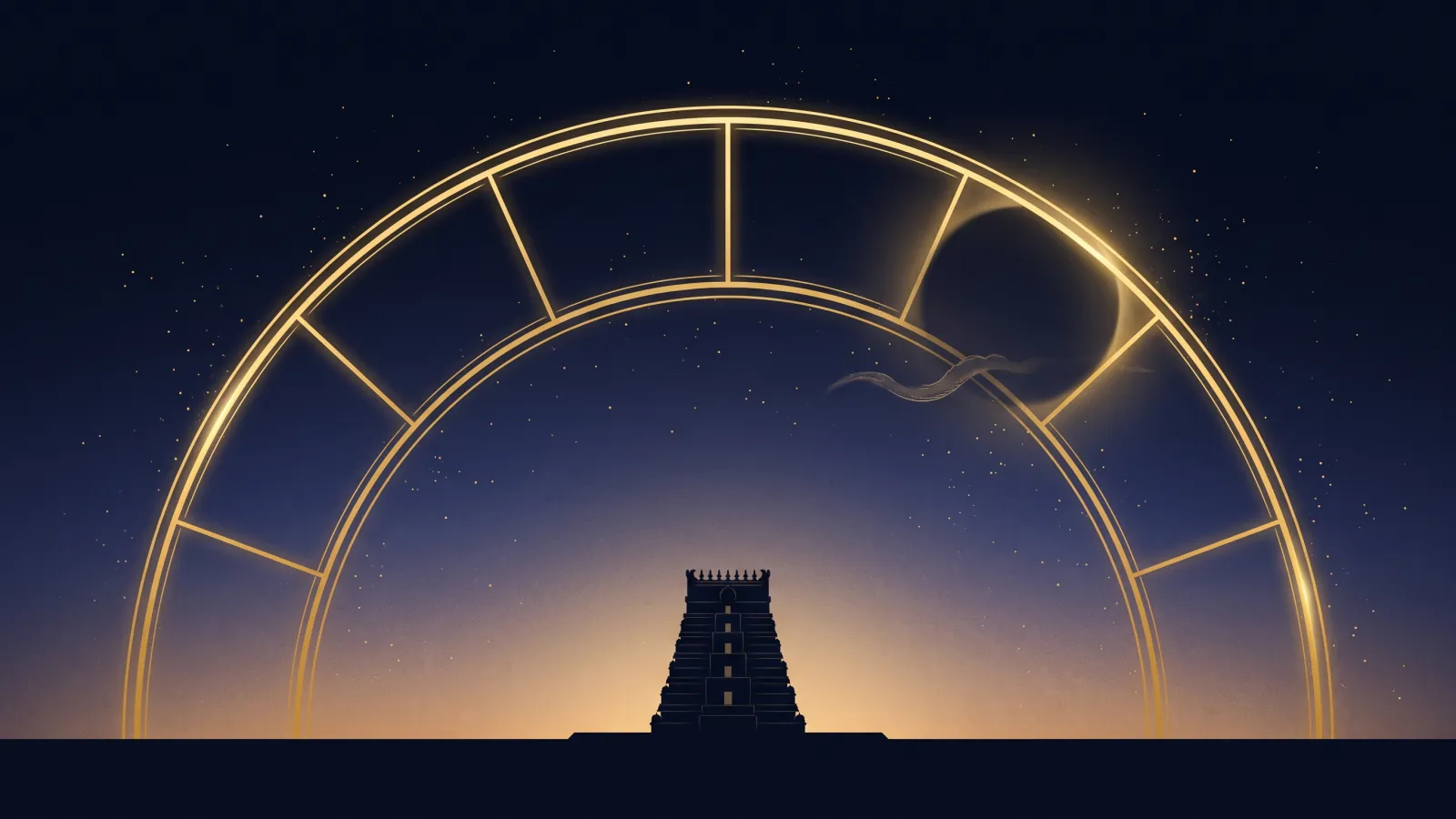
- Divide the daylight into eight equal parts; Rahu Kaal is the part set by the weekday.
- It lasts a day's daylight divided by eight: about 90 minutes near the equinoxes, shorter in winter, longer in summer.
- Tradition says not to begin new ventures, sign or set out on a journey in it. Work already under way, and prayer, are fine.
- Yamaganda and Gulika kaal are two more daily windows, computed the same way.
Rahu Kaal today in 10 cities
| City | Rahu Kaal | Date | Sunrise | Sunset |
|---|---|---|---|---|
| New Delhi | 7:44 AM to 9:12 AM | Mon 5 Oct | 6:16 AM | 6:02 PM |
| Mumbai | 7:59 AM to 9:28 AM | Mon 5 Oct | 6:29 AM | 6:23 PM |
| Bengaluru | 7:38 AM to 9:08 AM | Mon 5 Oct | 6:09 AM | 6:06 PM |
| Chennai | 7:28 AM to 8:57 AM | Mon 5 Oct | 5:58 AM | 5:56 PM |
| Dubai | 7:41 AM to 9:09 AM | Mon 5 Oct | 6:12 AM | 6:01 PM |
| London | 8:32 AM to 9:58 AM | Mon 5 Oct | 7:07 AM | 6:29 PM |
| New York | 8:23 AM to 9:50 AM | Mon 5 Oct | 6:56 AM | 6:31 PM |
| Toronto | 8:46 AM to 10:12 AM | Mon 5 Oct | 7:19 AM | 6:51 PM |
| San Francisco | 8:36 AM to 10:03 AM | Mon 5 Oct | 7:09 AM | 6:46 PM |
| Sydney | 8:01 AM to 9:35 AM | Mon 5 Oct | 6:27 AM | 7:00 PM |
What is Rahu Kaal?
Rahu is one of the two lunar nodes, the points where the Moon's path crosses the Sun's, and in Jyotish it is a shadow graha associated with eclipses, confusion and obsession. Each day, one eighth of the daylight is assigned to Rahu, and the tradition treats it as the day's blind spot: a poor time to begin anything that needs to hold.
- of the daylight, every day
- 1/8of the daylight, every day
- near the equinoxes
- About 90 minnear the equinoxes
- Rahu Kaal, Yamaganda and Gulika kaal
- 3 windowsRahu Kaal, Yamaganda and Gulika kaal
It is observed most strictly in South India, where it is called Rahu kalam, and every panchang prints it alongside Yamaganda and Gulika kaal.
How is Rahu Kaal calculated?
Find sunrise and sunset
Find the local sunrise and sunset for the date and place.
Cut the daylight into eight
Divide the time between them into eight equal parts.
Take the weekday's part
Take the part for the weekday: Sunday 8th, Monday 2nd, Tuesday 7th, Wednesday 5th, Thursday 6th, Friday 4th, Saturday 3rd.
A common way to remember the order, Monday to Sunday: 'Mother Saw Father Wearing The Turban Suddenly'. Monday is the 2nd part, Saturday the 3rd, Friday the 4th, Wednesday the 5th, Thursday the 6th, Tuesday the 7th and Sunday the 8th.
Rahu Kaal timings with a 6 AM sunrise
Drawn for a 6 AM sunrise and a 6 PM sunset. On any real day, the eight parts follow that day's own sunrise and sunset.
| Day | Rahu Kaal | Yamaganda | Gulika kaal |
|---|---|---|---|
| Sunday | 4:30 PM to 6:00 PM | 12:00 PM to 1:30 PM | 3:00 PM to 4:30 PM |
| Monday | 7:30 AM to 9:00 AM | 10:30 AM to 12:00 PM | 1:30 PM to 3:00 PM |
| Tuesday | 3:00 PM to 4:30 PM | 9:00 AM to 10:30 AM | 12:00 PM to 1:30 PM |
| Wednesday | 12:00 PM to 1:30 PM | 7:30 AM to 9:00 AM | 10:30 AM to 12:00 PM |
| Thursday | 1:30 PM to 3:00 PM | 6:00 AM to 7:30 AM | 9:00 AM to 10:30 AM |
| Friday | 10:30 AM to 12:00 PM | 3:00 PM to 4:30 PM | 7:30 AM to 9:00 AM |
| Saturday | 9:00 AM to 10:30 AM | 1:30 PM to 3:00 PM | 6:00 AM to 7:30 AM |
These are the fixed times many calendars print. They are exact only when sunrise is at 6:00 and sunset at 18:00; everywhere else, and on every other day of the year, use your own city's times.
What should you avoid during Rahu Kaal?
Traditionally avoided
- Starting a new business, job or project.
- Signing contracts or making large purchases.
- Setting out on a journey, or a griha pravesh, moving into a new home.
- Engagements, weddings and other ceremonies.
Not affected
- Work already under way, and routine tasks.
- Prayer, especially to Durga, which many families keep in exactly this window.
- Anything that cannot wait. The tradition never asks you to miss a train or a doctor's appointment.
Yamaganda and Gulika kaal
Two more daily windows are computed the same way, each one eighth of the daylight chosen by the weekday. Yamaganda, ruled by Yama, is traditionally avoided for travel and important beginnings. Gulika kaal, the part of the day belonging to Gulika, Saturn's son, is read as a time when whatever is begun tends to repeat, so it is avoided for anything you would not want to happen again.
Rahu Kaal and Abhijit muhurta
The counterweight is Abhijit muhurta, the eighth of the fifteen muhurtas of the daylight, spanning local noon. Classically it is the day's safety net: an auspicious window that overrides most other faults. It is not observed on Wednesday.
Horoskope's free reading shows today's Rahu kala and Abhijit in its Vedic panel, and the Today tab in the app gives your best windows of the day, with what each one is good for.
The page that does this for you: Your free daily brief.