What is a mahadasha and antardasha?
Western astrology is very good at describing who you are. Vedic astrology adds a clock. While a planet's period runs, the tradition says that planet's promises in your chart come due.
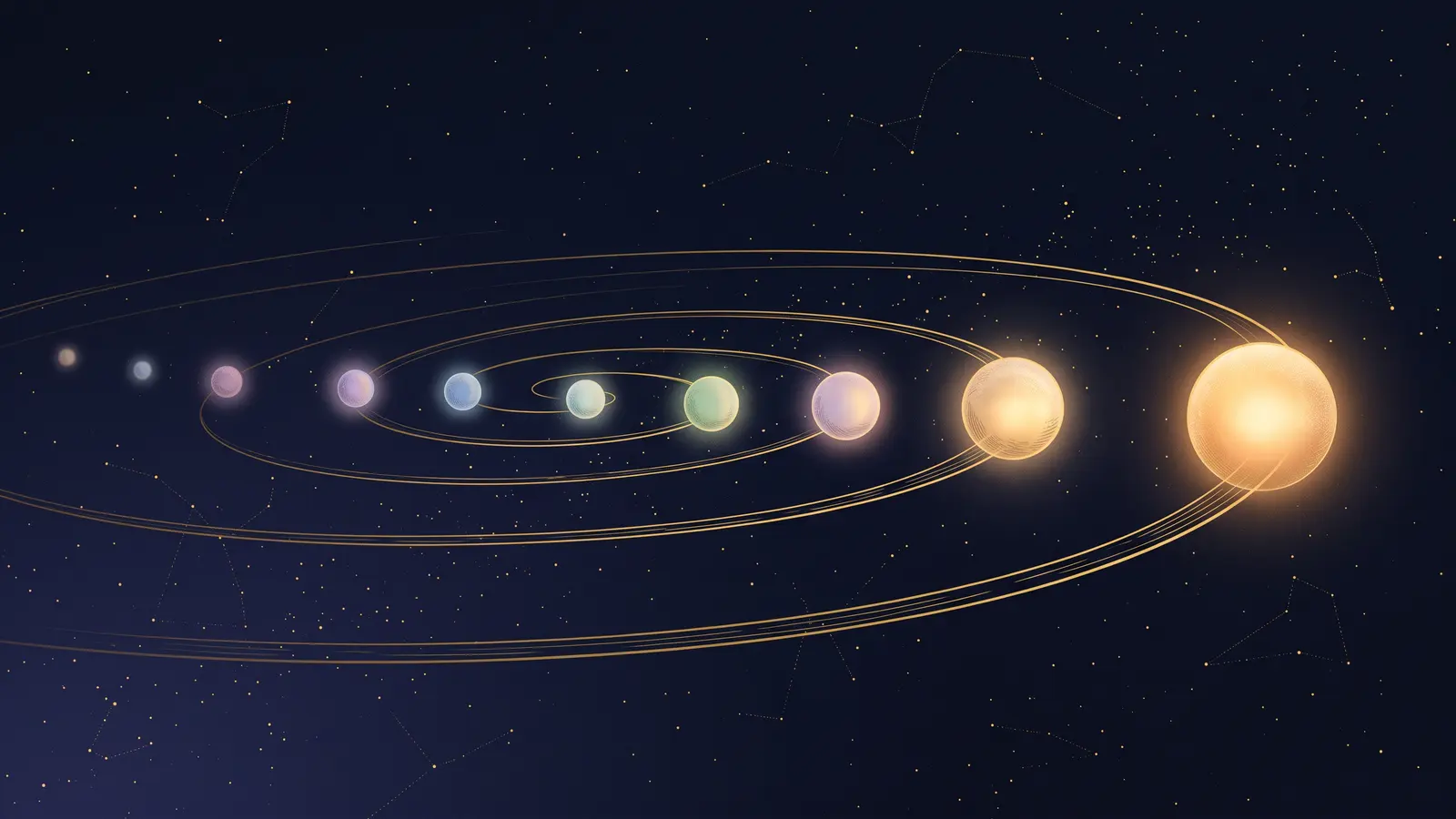
The mahadashas run in this order: Sun 6 years, Moon 10, Mars 7, Rahu 18, Jupiter 16. Then Saturn 19, Mercury 17, Ketu 7 and Venus 20. Together they cover 120 years. Where you start in the cycle is set by the Moon's position at birth.
Inside each mahadasha run shorter antardashas in the same order, so the flavour of a year is the long period coloured by the short one. 'Jupiter mahadasha, Saturn antardasha' reads very differently from 'Jupiter mahadasha, Venus antardasha'.
This is why a Vedic reading can say, for example, that the window for a move runs from one month to another, where a Western one says you are the kind of person who moves. Both are true; only one is dated. In Horoskope, dated windows come with Pro.
Your current period, and the day it turns over, is computed from your birth details below. If your birth time is unknown, the dates are estimates and the reading says so. The free reading shows it when you switch it to 'I know my chart', and the birth chart calculator does the same.
The page that does this for you: Birth chart calculator.
Which planet's period were you born in?
Your first dasha is set by one fact: the nakshatra, or lunar mansion, that the Moon occupied when you were born. The sky is divided into 27 nakshatras of 13°20' each, and each one has a ruling planet. The planet that rules your birth nakshatra rules the first period of your life.
The nine rulers repeat three times around the zodiac, in the dasha order itself. Ashwini is ruled by Ketu, Bharani by Venus, Krittika by the Sun, and so on to Mercury. Then the pattern starts again at Magha, and again at Mula. The 27 nakshatras lists the ruler of every one.
So the cycle has no fixed first planet. It starts wherever your Moon was. Someone born with the Moon in Rohini begins in a Moon period. Someone born with the Moon in Pushya begins in a Saturn period, and meets the Mercury, Ketu and Venus periods next.
How much of your first period was left at birth?
You rarely start a period on its first day. The tradition measures how far the Moon had already travelled through your birth nakshatra, and treats that share of the first period as spent before you were born. Only the remainder, called the balance of dasha, is yours.
A worked case makes it plain. Say the Moon sits a quarter of the way through Rohini, which the Moon rules. A quarter of the Moon's 10 years is gone, so the chart opens with seven and a half years of Moon period. Then Mars runs its full 7 years, Rahu its 18, and the rest follow in order.
This is why two babies born in the same week can open very differently. One may begin with fifteen years of Venus still to run, the other with a few months of the Sun. It is also why no life runs the cycle from a clean start: the first period is almost always a remainder, and a long life passes through several of the nine periods, not all of them in full.
Mahadasha, antardasha and pratyantardasha: the three layers
Each mahadasha divides into nine antardashas, and each antardasha divides again into nine pratyantardashas, often shortened to pratyantar. The rule is the same at every level. The period is shared among the nine planets in proportion to their years out of 120, starting with the period's own planet.
The arithmetic is simple. An antardasha lasts the mahadasha's years times the sub-period planet's years, divided by 120. Mercury's antardasha inside a 19-year Saturn mahadasha is 19 times 17 over 120, about two years and eight months. The Sun inside its own 6-year period lasts about three and a half months, while Venus inside Venus runs three years and four months.
Across the whole cycle there are 81 antardashas, so they average about a year and a half each. There are 729 pratyantardashas, averaging about two months, though the shortest last only days and the longest several months. A fourth level, sookshma, divides once more, down to the scale of days.
Read together, the layers work like a calendar. The mahadasha is the chapter, the antardasha is the season inside it, and the pratyantardasha is the stretch of weeks you are living now.
How to read the chapter you are in
A period brings the business of its planet, and the tradition finds that business in your own chart rather than in a general list. Two people in the same Venus mahadasha can have almost nothing in common, because Venus rules different houses in their charts and sits in a different sign.
So start with the mahadasha planet and ask four questions of your chart. Together the answers describe what the chapter tends to be about.
Then look at the antardasha planet in the same way, and read it as the colour laid over the chapter. Planets that are natural friends tend to blend. Planets that are not give a season with two pulls in it.
- Which house does it occupy? That area of life tends to come forward.
- Which houses does it rule? Their affairs come due as well. Rahu and Ketu rule no sign, so their periods are read through the sign they sit in and the planet that rules it.
- How comfortable is it? A planet in its own sign or its sign of exaltation works more easily than one in its sign of debilitation, where the tradition says it struggles.
- What does it stand for by nature? Saturn for work and duty, Mercury for learning and speech, Jupiter for wisdom and children, Venus for partnership and comfort, the Sun for authority, the Moon for home and feelings, Mars for courage and property.
Why your birth time matters for dasha dates
Every date in your dasha timeline hangs from one number: the Moon's exact degree at birth. The Moon moves about half a degree an hour. An hour's error in the birth time therefore moves the balance at birth, and every later date moves with it.
How far depends on the planet you were born under. For a chart that opens in a Sun period, one hour shifts the timeline by roughly three months. For one that opens in Venus, it is roughly nine months, and the whole sequence slides together.
Near the edge of a nakshatra the stakes are larger. An hour or two can move the Moon into the next nakshatra, which changes the planet you started under and reorders the whole timeline. If your time is rounded or remembered, treat the change dates as estimates, and see the birth details guide for where a recorded time can be found.
Dasha, transit and Sade Sati: how they differ
A dasha is a clock set at birth. A transit, or gochar, is where a planet stands in the sky today, read against your chart. The two run independently, and a Vedic reading weighs them together.
Sade Sati, Saturn's passage over the three signs centred on your Moon, is a transit, not a dasha. It lasts about seven and a half years whatever period you are in. The tradition reads it more gently or more heavily depending on the dasha running alongside it.
One more common mix-up: a period does not begin on your birthday. Its start date comes from the Moon's balance at birth, so a new antardasha can begin in any month of the year.